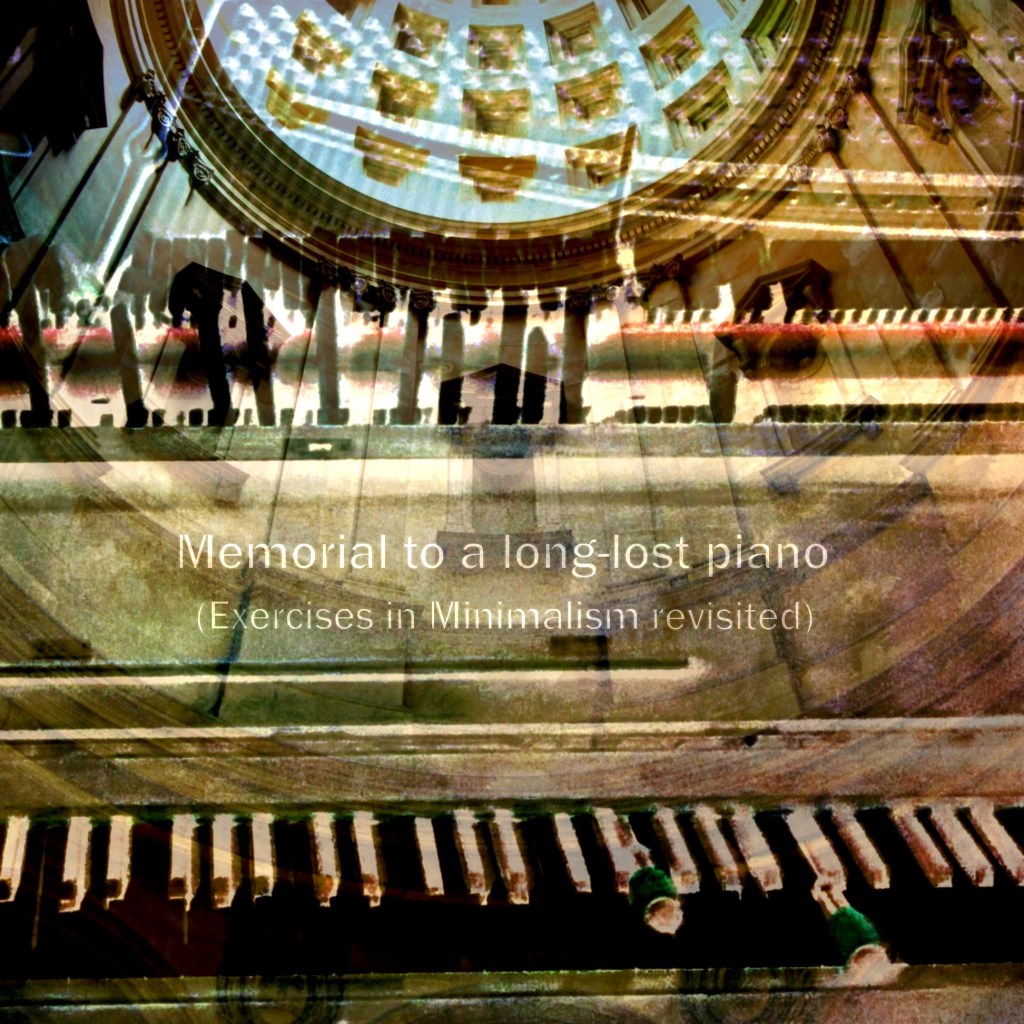
The present work originates from an intimate engagement with a personal sound archive. In 2017, I recorded the interior resonance of an upright piano that had accompanied my childhood — an instrument now lost, along with the family home in which it stood. These recordings, focusing on the raw timbral qualities of the strings, became the basis for Exercises in Minimalism (2018).
The material was subjected to reductive processes: attacks were removed, durations extended, and harmonic overtones isolated and layered to form sustained piano drones. Through this process, the familiar sound of the piano was transformed into an abstract field of resonance, emphasizing texture over gesture and continuity over articulation.
Eight years later, I returned to these recordings and composed a new piece derived entirely from the earlier material. Conceived as a funeral music for the lost piano, the work employs convolution reverb generated from the Hamilton Mausoleum — a site renowned for its exceptionally long and unpredictable echo. The resulting spatialization situates the reconstructed piano sounds within a vast and reverberant acoustic environment, blurring the boundaries between presence and absence, memory and space.
This composition explores the intersection of personal memory, acoustic space, and sonic decay. By recontextualizing archival sound within an architectural reverberation, it examines how listening can become an act of remembrance.
 Ausgesuchtestenohren
Leave a comment