The title is deliberately worded ambiguously. On the conventional level of language, ‘After Harnik’ means inspired by a work by Elisabeth Harnik. This work is her spatial composition for choirs and instrumentalists based on texts by Heraclitus and Sappho entitled “in change is rest” (2022-2023), the performance of which at Wien Modern on November 25, 2023 in the Kalvarienbergkirche in Vienna moved me very much. I was initially moved to record the sounds of movement and conversations of the audience immediately after the concert. I was then moved to respond to Harnik’s piece and its performance with my own composition. Some essential elements of Harnik’s composition played a key role: the pedal point, which is continuous for me (in Harnik it lasts for a very long time, but is not continuous), the beats that arise from tones that are close together and, above all, the division of the choir in the room. The “choir” in my case is the audience recorded after the concert. I divided this recording into individual “choir groups” and “choir parts” and then distributed it throughout the (virtual) church space. I then highlighted certain frequency bands in order to reinforce the psychoacoustic impression of the “singing” of the audience that I had already had when I recorded it after the concert. So after the choirs’ songs have been heard in the performance of Harnik’s piece, the singing continues with the voices of the audience of this performance and at the same time transforms into another “song”: in change is rest. After the concert nothing is the same as it was before the concert. The concert not only moved me internally, but made me act, immediately in the recording of the audience after the concert and later in the compositional reaction to my experience with Harnik’s piece. I hope that this compositional reaction can enter into dialogue with the music of Elisabeth Harnik: in change is rest – after Harnik.
After Harnik: a compositional response
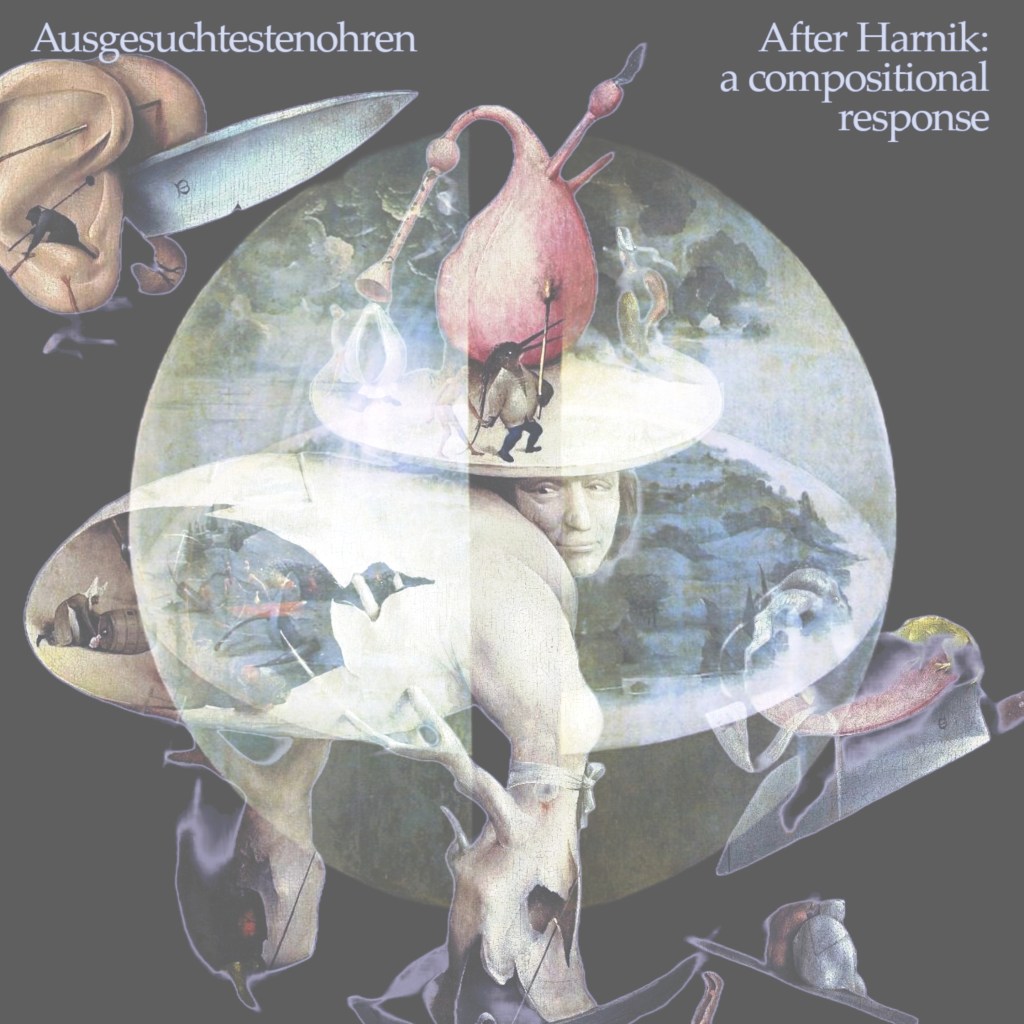
 Ausgesuchtestenohren
Leave a comment