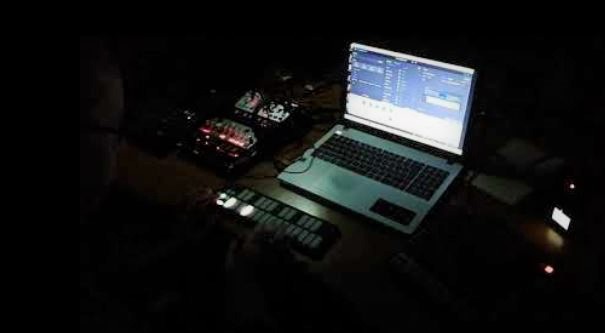
(and my drone piece The Trumpet, Casting a Wondrous Sound in Tombs)
Scene 2 of act 3 of Alban Berg’s Wozzeck is an Invention on a note (B♮). It is the scene in which Wozzeck kills his girlfriend and mother of their child Marie. B♮ symbolized death for Alban Berg, who despite of the fact that he, with dodecaphony, used a very rational technique in Wozzeck, did have a penchant for the esoteric and occult, especially for number mysticism. Twelve-tone technique did not beware him to believe in tone-symbolism either. But apart from these esoteric overtones, which I do not believe in, I consider Berg´s invention on a single tone as one of the most radical applications of the formal concept of invention both in the context of traditional tonal music and dodecaphony. The scene is followed by a short interlude, which is nothing else but two orchestral swells on the note B♮, the first ending with the rhythm of death – indeed, Berg did have a rhythm of death too – played on the timpani, the climax of the second swell is instantaneously (attacca) followed by a polka which has to be played on a detuned upright piano on the stage.
My own drone piece The Trumpet, Casting a Wondrous Sound in Tombs is also a kind of invention on the note B♮. It is a very slow swell of 4 different synthesizer patches complemented by sampled trombones and tubas in the last third where also other pitches are added. The 4 synthesizer layers are slightly detuned in order to trigger a variety of overtones. Hence, the sound is constantly and subtly changing in time. The title of the piece is two lines of the Tuba mirum, part of the Dies irae of the Requiem Mass. The primary historical context of my piece is of course drone-based music within minimalism, but the use of the B♮ as the sole pitch of two thirds of the piece, the detuning of the layers and the title with its reference to death are also a nod to Alban Berg, whom I consider as an inventor of drone with his invention on a note.
 Ausgesuchtestenohren
Leave a comment